
Downtown Oberlin. Group of people sitting at a table outside a local restaurant.

Fall 2025

Oberlin’s Economic Impact

Oberlin College and Conservatory has been physically, socially, and economically intertwined with the city of Oberlin since our shared founding in 1833. Our campus sits at the heart of the city, and our setting in Northeast Ohio is an important part of who we are. We are proud of what we contribute to the city of Oberlin, Lorain County, and Northeast Ohio, and believe we make this region stronger. 

Oberlin is a major contributor to the economic health of Northeast Ohio, generating significant income for its residents and supporting thousands of jobs. A 2025 study by workforce analytics company Lightcast shows that Oberlin delivers strong returns for its key stakeholders—students, society, and taxpayers—while strengthening the regional business community.

Northeast Ohio

$283.1 million Added to the regional economy

3,271 Jobs supported

Economic Impact

In fiscal year 2023–24, Oberlin added $283.1 million to the Northeast Ohio economy, supporting 3,271 jobs.

Operations spending

  • Payroll amounted to $107.1 million, much of which was spent locally.
  • The college spent another $87.7 million on expenses related to facilities, supplies, and professional services (excluding construction).
  • The net impact of the college’s operations spending added $154.4 million in income to the regional economy.

Construction spending

Oberlin invests in capital projects each year to maintain its facilities, create additional capacities, and meet growing educational demands. This generates jobs and short-term economic boosts.

  • Construction spending in FY 2023-24 generated $36.4 million in added income.

Visitor spending

Thousands of out-of-region visitors to Oberlin brought new dollars to Northeast Ohio businesses, adding $6.6 million in income.

Every dollar Oberlin spends ripples across Northeast Ohio—supporting thousands of jobs and strengthening local businesses.

$154.4 million Operations spending impact

$36.4 million Construction spending impact

$6.6 million Visitor spending impact

Student spending

Approximately 96 percent of students attend Oberlin from outside the region. In addition, some in-region students would have left Northeast Ohio for other educational opportunities if not for Oberlin. These students contributed $11.3 million in income to Northeast Ohio through services, food, and other expenses.

Volunteerism

The work of Oberlin’s student volunteers allows businesses and organizations to grow, increasing their output and impacting the economy at large.

  • Using the value per volunteer hour for Ohio, the work of Oberlin student volunteers is equivalent to $369,900 in earnings.
  • In terms of actual impact on the regional economy, student volunteers generated an impact of $444,000 in added income in FY 2023-24.

Alumni impact

Thousands of Oberlin alumni live and work in Northeast Ohio, particularly in government, education, professional and technical services, health care and social assistance, and arts and entertainment. Their presence in the regional workforce amounted to $74.0 million in added income.

One out of every 59 jobs in Lorain County is supported by the activities of Oberlin and its students.

Ohio taxpayers gain nearly $27 million in benefits from Oberlin—without contributing state or local funding.

$11.3 million Student spending impact

$0.4 million Volunteerism impact

$74.0 million Alumni impact

Student Investment

  • Oberlin invested $94.7 million in tuition, fees, supplies, and interest on student loans.
  • In return, they will receive $105.4 million in higher lifetime earnings in Ohio—a return of $1.10 for every dollar invested, with an annual rate of return of 5.1 percent.
  • Factoring in national settlement rates where most alumni live, returns rise to $1.80 per dollar invested, with an annual return rate of 8.4 percent.

Taxpayer Benefits

Although Oberlin receives no local or state government funding, Ohio taxpayers benefit through:

  • $23.7 million in added tax revenue from higher earnings and increased business output.
  • $3.1 million in savings from reduced demand for public services.

$26.7 million State taxpayers gain in added tax revenue and public sector savings

All results reflect employee, student, and financial data provided by the college for fiscal year 2023-24.

Lightcast also studied the economic value of Oberlin College to Lorain County specifically. Read the executive summary here.

For the purposes of this analysis, Northeast Ohio comprises Ashland, Cuyahoga, Erie, Geauga, Huron, Lake, Lorain, Medina, Portage, Richland, Stark, Summit, Tuscarawas, and Wayne counties.
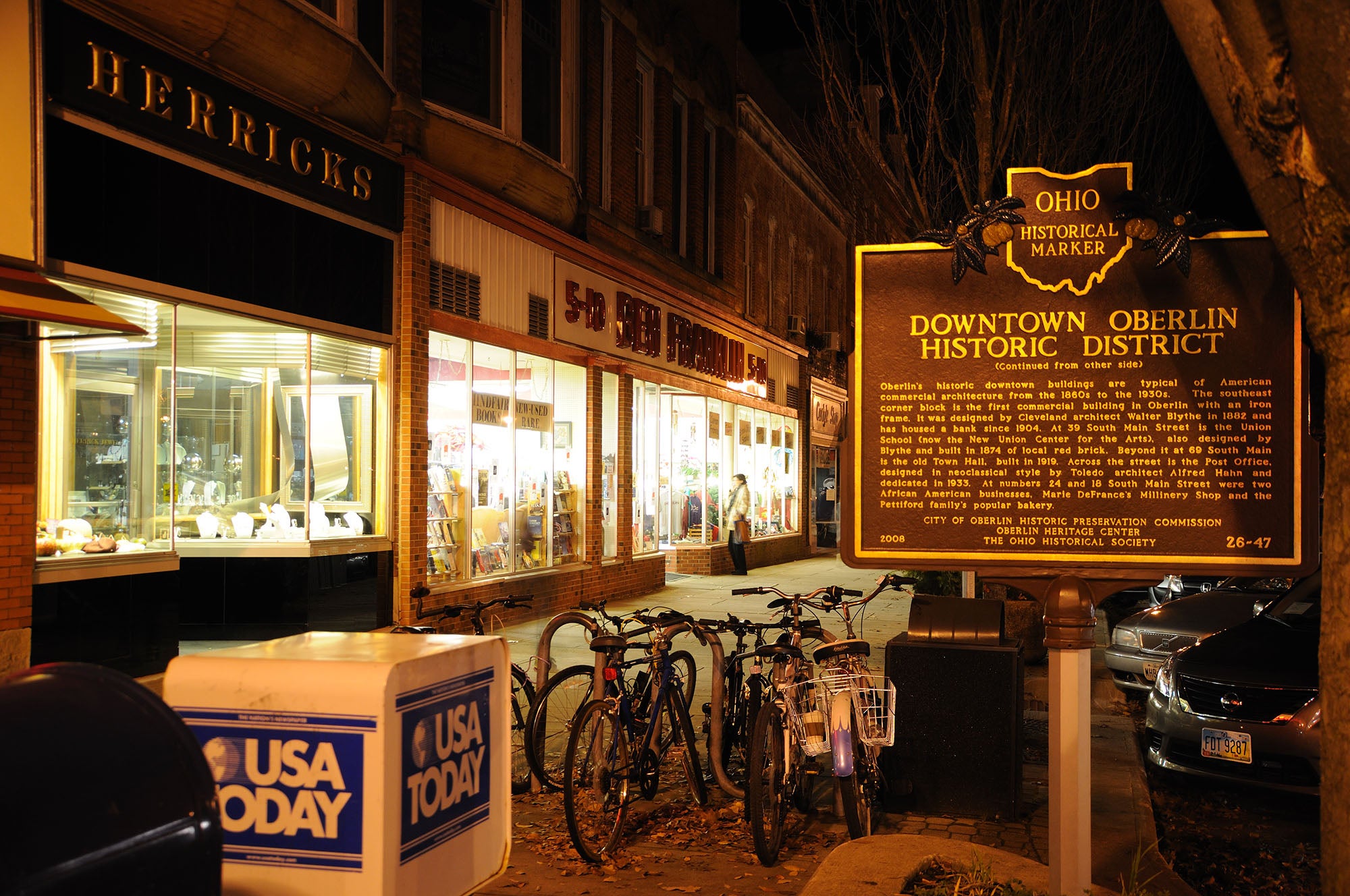
Night view of downtown Oberlin