Program Overview
Engineering
Pursue applied science within the liberal arts.
Engineer Solutions to Real-World Problems
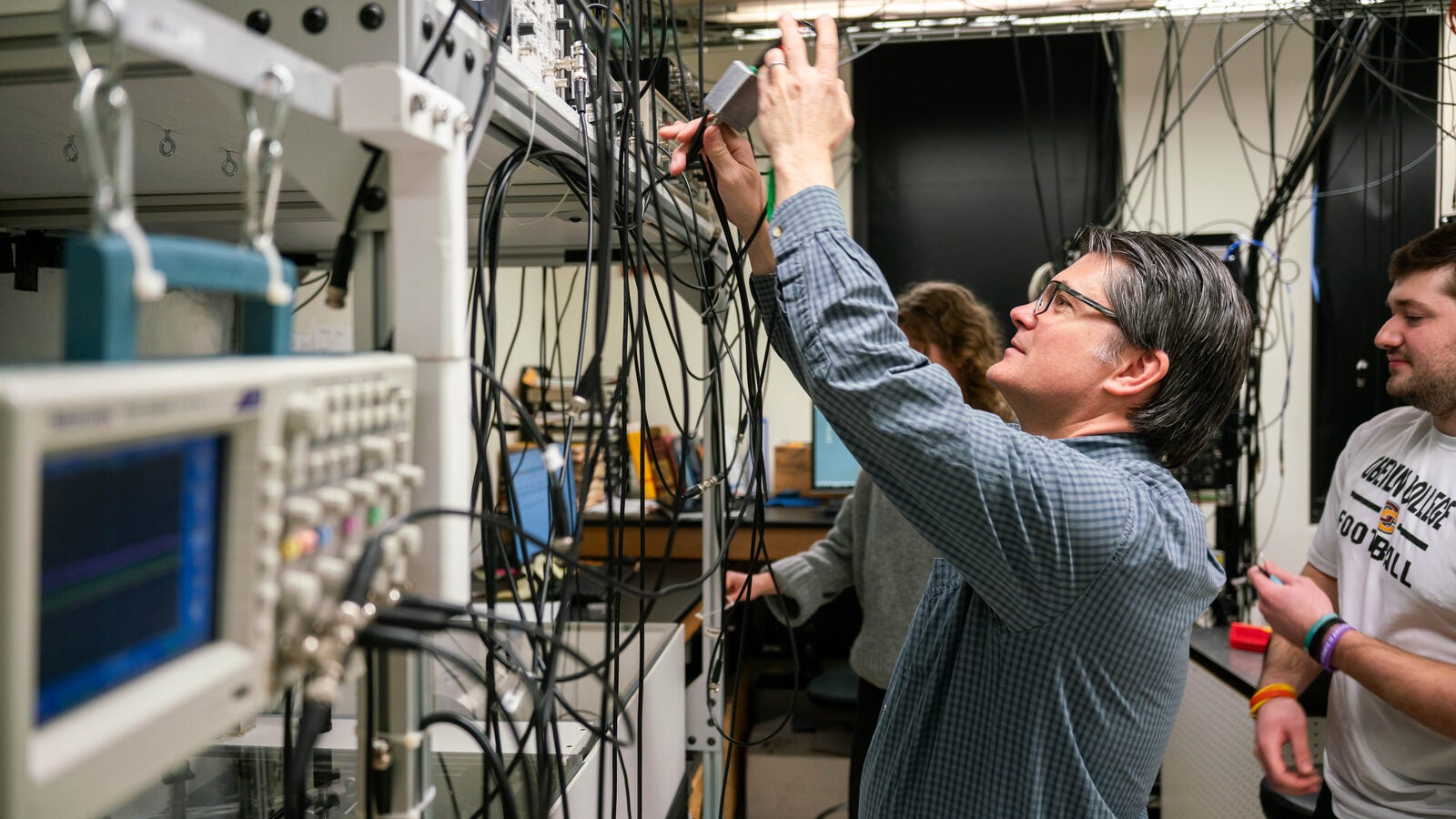
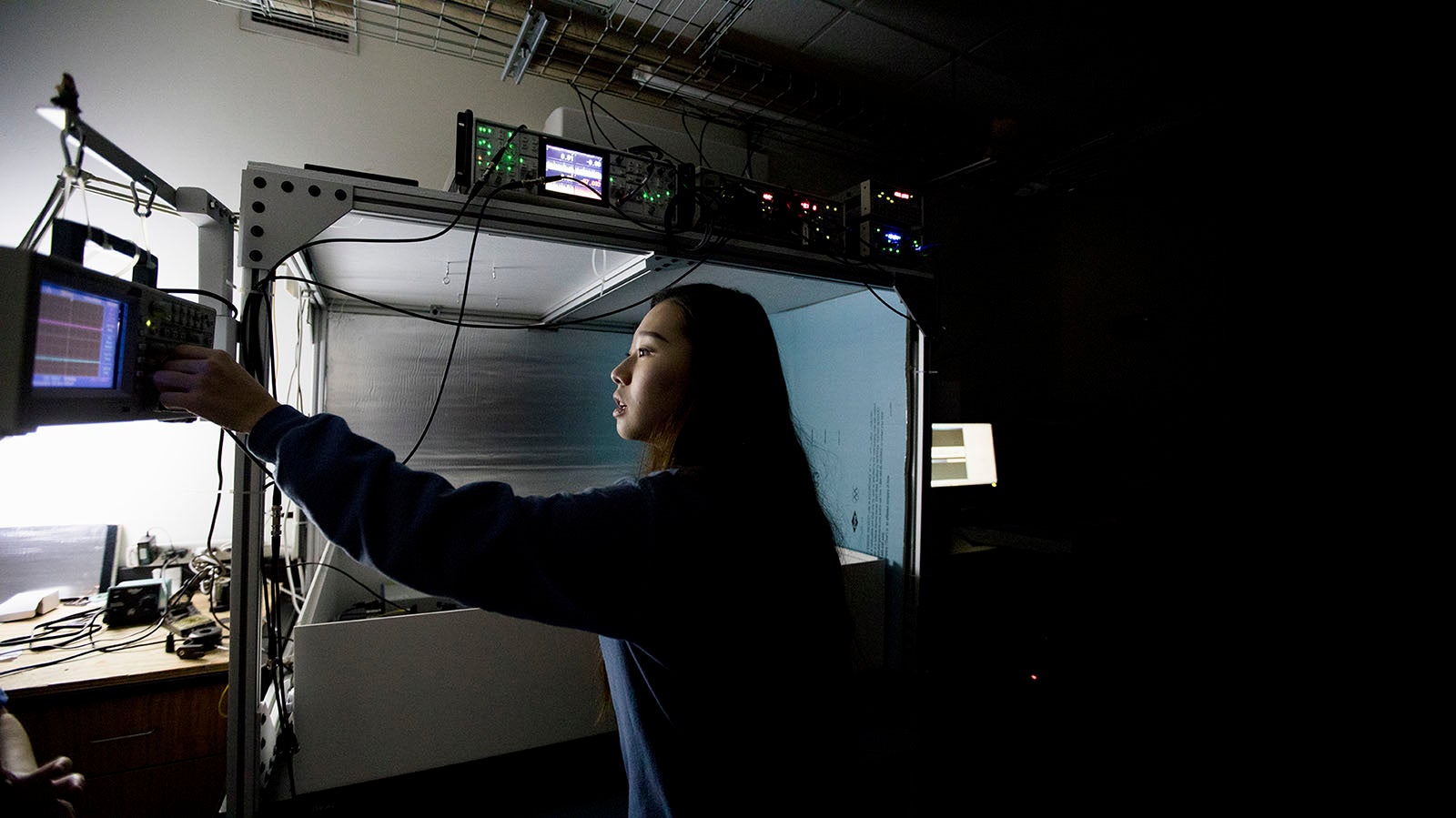
Practicing engineers devise solutions to real-world problems within a range of constraints, from laws and ethics to costs and environmental impacts. As the Latin root of the name suggests, engineers need to be ingenious in their design of solutions.
Engineering at Oberlin includes the core elements that make ingenuity a possibility: mathematics, science, and the qualities our liberal arts education fosters—curiosity, collaboration, the ability to see a problem from all angles, and an appreciation for the bigger picture. Two five-year pathways build that foundation for engineering majors.
Oberlin offers two routes into engineering. Each pairs a full liberal arts foundation with an accredited engineering degree from a partner school, 4+1 Engineering and 3+2 Engineering.
4+1 Engineering
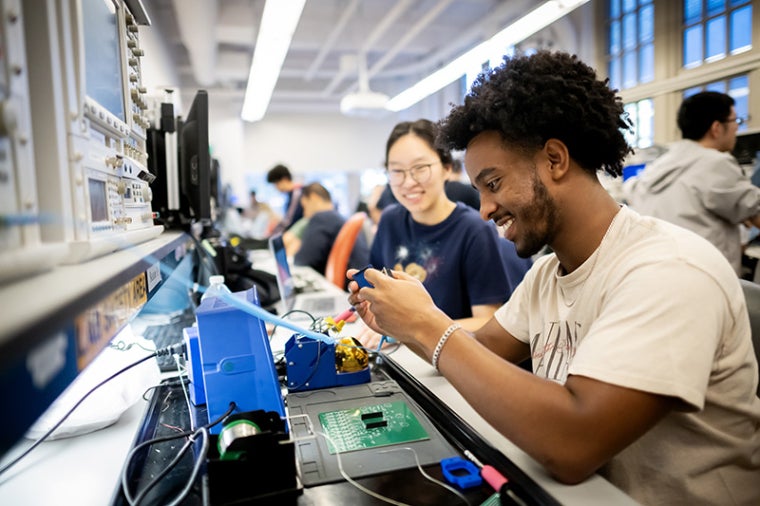
Spend all four undergraduate years at Oberlin and one year at the University of Pennsylvania’s School of Engineering and Applied Science. You’ll choose one of five specialized pathways—Biotechnology, Energy and Sustainability, Materials Science, Scientific Computing, or Systems Engineering—and apply directly to Penn Engineering in your fourth year, transferring up to three pre-approved Oberlin courses toward the master’s degree. You’ll earn a bachelor’s degree from Oberlin and a Master of Science in Engineering from Penn. Because all four undergraduate years are spent here, the 4+1 gives you more flexibility to double major, and varsity scholar-athletes can compete during all four seasons.
3+2 Engineering
Spend three years at Oberlin and two at a partner engineering school: California Institute of Technology, Case Western Reserve University, Columbia University, or Washington University in St. Louis. You’ll take your prerequisites here at Oberlin, then complete an accredited sequence of engineering coursework at your partner institution, earning a Bachelor of Arts from Oberlin and a Bachelor of Science in Engineering from your partner school.
Planning and Applying
For both engineering pathways, we recommend focusing on mathematics and chemistry or physics coursework in your first year. Specific requirements vary by partner school and by Penn pathways.
Applications to Penn Engineering are due February 1 following your seventh semester at Oberlin. Admission is selective and not guaranteed; students apply with a minimum 3.0 cumulative GPA and a 3.2 GPA in mathematics, science, and engineering coursework. Students admitted to the 4+1 are responsible for tuition and fees during the fifth year at Penn.
Engineering by the Numbers
Featured Facts and Stories
Two pathways into engineering: four partner schools, or five Penn specializations.
Pathways in Science and Technology
Oberlin’s Career Communities provide structured opportunities for students to pursue postgraduate career plans, placing interested students at organizations ranging from the Environmental Protection Agency to Medtronic and Google.

$13,000 Each year Oberlin connects entrepreneurial students with startup funding. Last year, our students received
STEM in Color
Oberlin's STRONG program (Science and Technology Research Opportunities for a New Generation) reflects the college's ongoing commitment to increasing diversity in the STEM workforce.

Undergraduate Research

Hibatullah uses a scanning electron microscope-energy dispersive X-ray spectrometer to efficiently collect and analyze chemistry at the microscopic scale.
Featured Courses
PHYS 110
Mechanics and Relativity
Explore Newtonian mechanics and special relativity through conceptual learning, problem solving, and laboratory work. You'll examine topics ranging from motion, conservation principles, and rotation to time dilation, length contraction, and the relativity of simultaneity.
- Taught by
- Bryan Terrazas
CHEM 101
Structure and Reactivity in Chemistry
Study the fundamentals of chemistry through reactions, chemical periodicity, bonding, and atomic and molecular structure. Combining lecture and laboratory work, this introductory course builds a foundation for further study in chemistry, science, and engineering.
- Taught by
- Christina Hemmingsen
MATH 133
Calculus I
Build a foundation in calculus through the study of functions of one variable, including limits, continuity, differentiation, and integration. You'll also explore the fundamental theorems of calculus and apply what you learn to solve a range of mathematical problems.
- Taught by
- Madelyne Brown
CSCI 150
Introduction to Computer Science
Develop algorithmic thinking and problem-solving skills through computer programming. You'll explore programming fundamentals and object-oriented concepts, then put them into practice through labs with applications in fields ranging from mathematics and physics to biology, graphics, and music.
- Taught by
- Michael McCarrin
Student Profiles
Mixing Art and Engineering
Enrico Milletti ’19, a visual arts major in the 3+2 Engineering program, was selected for the Louis Sudler Prize in the Arts. “I am interested in mechanical engineering because it is very hands-on and concerned with design thinking, just like my current work in studio art,” says Milletti.

Building Blocks for a Dynamic Future
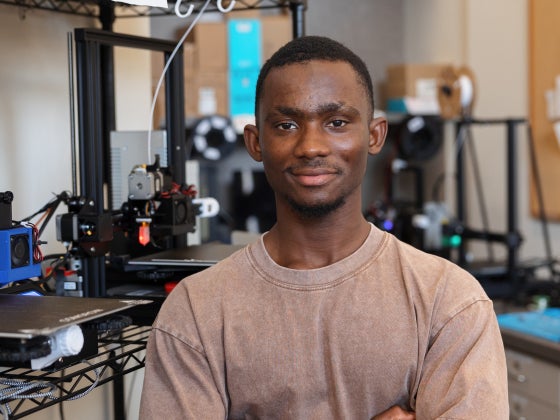
Engineering 3+2 student Frank Kusi Appiah ’29 has collaborated on several ecological projects on campus, designing and building sensors used for micro-agriculture and tracking energy usage. After completing his three years at Oberlin, he plans to transition to Columbia University to complete his engineering program.
Lemelson-MIT Prizewinner
Jay Whitacre ’94, entrepreneur, inventor, and professor at Carnegie Mellon University’s College of Engineering, received the $500,000 Lemelson-MIT Prize for the Aqueous Hybrid Ion battery, which has the potential to revolutionize the way sustainable energy is stored.

Next Steps
Get in touch; we would love to chat.