
Student Project Profile
Investigating the role of D1Rs in sex differences in cocaine-induced impulsivity
Project Title
Investigating the role of D1Rs in sex differences in cocaine-induced impulsivity
Faculty Mentor(s)
Project Description
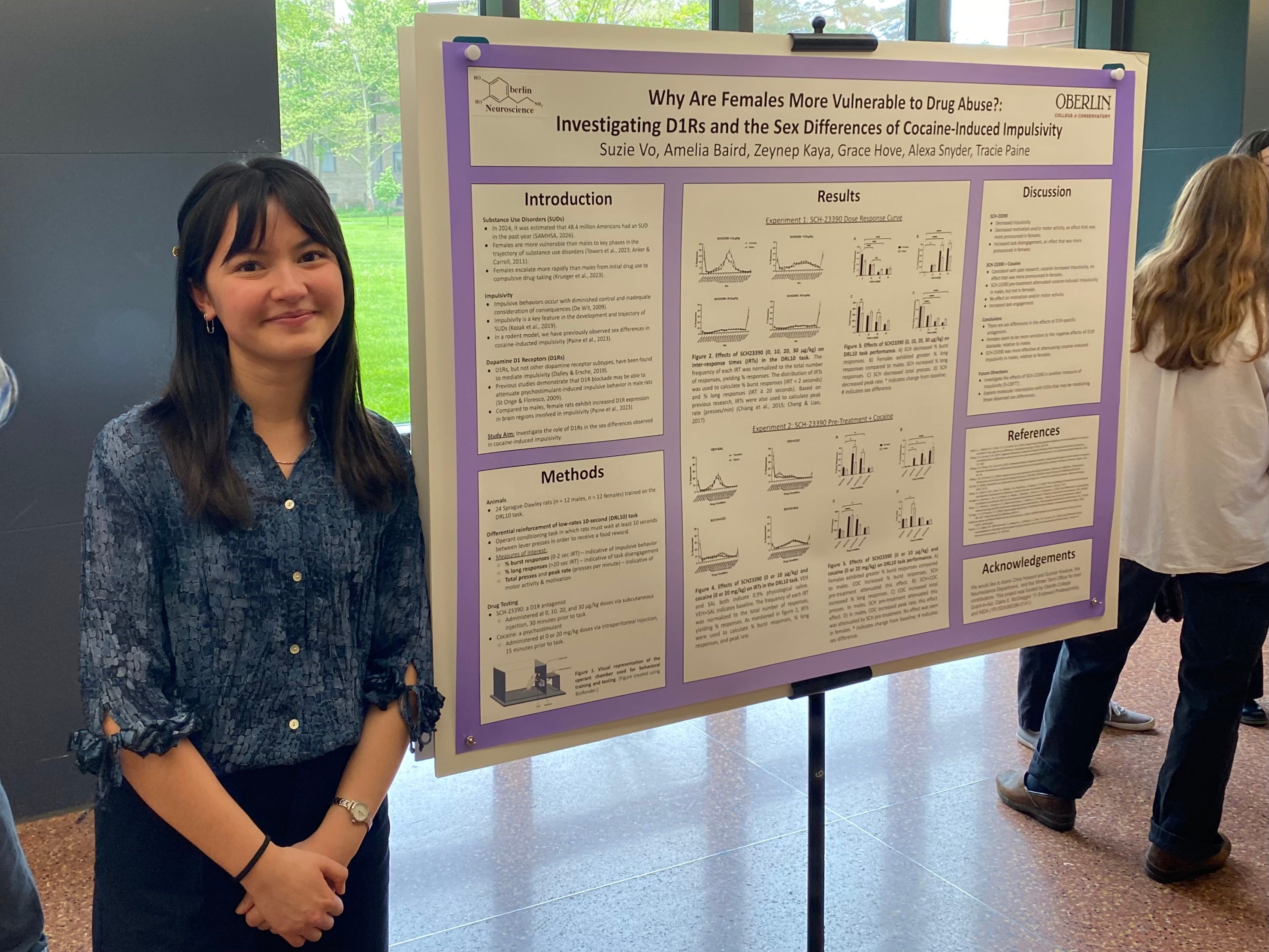
Females are more vulnerable than males to key phases in the trajectory of substance use disorders (SUDs). This project seeks to better understand the neurobiological basis of these sex differences by examining the contribution of dopamine D1 receptors (D1Rs) in cocaine-induced impulsivity. In male and female rats, impulsivity was measured using the DRL10 task, an operant conditioning task. The effects of cocaine (a psychostimulant) and D1R-specific drugs on impulsive behavior were analyzed. Results suggest that females are more sensitive to the effects of D1R modulation compared to males. This research may help to inform gender-specific treatment options for SUDs.
Why is your research important?
This research is important because it seeks to fill a gap in the literature about the neurobiological basis of sex differences in substance use disorders. If we can identify the mechanism of these sexual dimorphisms, we will be one step closer to developing sex-specific treatments for addiction.
What does the process of doing your research look like?
Research in the Paine Lab predominantly consists of behavioral testing. We work with our animals daily to train them on tasks, track their progress, and observe their behavioral responses to our drugs of interest. After we’ve collected all our behavioral data, we analyze our results and identify if the data agree with our hypotheses!
In what ways have you showcased your research thus far?
A huge part of my Honors project has been communicating my research to others. I’ve presented my talk publicly several times, including most recently at the OUR Symposium.
How did you get involved in research? What drove you to seek out research experiences in college?
To me, the most exciting aspect of studying science is realizing that we have so much left to learn. I was driven to seek out research at Oberlin because I wanted to contribute to expanding scientific knowledge about the brain. I joined the Paine Lab in the same semester I took Professor Paine’s upper-level neuroscience course, Neuropharmacology. Joining the lab concurrently with taking Tracie’s class allowed me to better understand the rationale behind our research projects, and to feel confident in my ability to work with animals.
What is your favorite aspect of the research process?
To me, the most fulfilling part of the research process is being able to carry out a project from start to finish. After months and months of data collection and analysis, it is so gratifying to finally have results that we can use to inform future research.
How has working with your mentor impacted the development of your research project? How has it impacted you as a researcher?
Professor Paine’s guidance and expertise have been absolutely instrumental to the success of my research. Throughout my Honors project, Tracie has supported my goals and allowed me to pilot new techniques in the lab, all while reminding me to be conscientious of the time and resources that each experiment would require. Through conducting research in the Paine Lab, I feel that I have grown significantly as a scientist, especially in my ability to overcome challenges in the experimental process.
How has the research you’ve conducted contributed to your professional or academic development?
Conducting research in the Paine Lab has solidified my interest in substance use disorders, which I hope to continue learning about from a clinical perspective in my future career as a physician.
Students

Suzie Vo ’26
fourth-year- Major(s):
- Neuroscience