

Program Overview
French and Italian
From cinema and literature to history and culture.
Explore Global French and Francophone Cultures
Featured Facts and Stories
Every year over twenty Oberlin students study at partner universities in Italian or French speaking countries.
Summer in Champagne
Discovering Champagne: The World in a Glass is a summer immersion course on Champagne—the drink and the región— for students who wish to study the French language through an engagement with culture and the natural world.

Oberlin College is among the top producers of Fulbright scholars in the United States
French Queer Media Activism
In celebration of the 50th anniversary of the birth of the feminist movement in France, Oberlin professors and guest speakers presented on topics ranging from militant film collectives during the 1970s to the Front homosexuel d’action révolutionnaire (FHAR) and the beginning of gay rights and AIDS activism in France.

Featured Courses
ITAL 101
Beginning Italian
Designed for students with no prior experience, this introductory course develops students’ abilities to speak, write, read and understand Italian within a culturally rich environment. It also introduces them to today’s Italians, their language, their culture and their varied lifestyles. Important goals will be for students to recognize regional accents, the difference between formal or informal context, and the political, historical and financial factors that influence Italian culture and language.
- Taught by
- Ivana Di Siena
CINE 250
French Cinema, Intersectional and Feminist
This historical survey of French cinema tells a story that has long been suppressed but rewritten by feminist scholars who did nothing less than excavate the many artistic and cultural contributions of women filmmakers from the beginning of film to its present. Students learn about the usual periods of French cinema (Surrealism, 1930s Poetic Realism, Occupation, New Wave, contemporary film), but also study film direction, stardom, acting, editing, and producing—all through its leading women. A study of the history of industrialization, cultural policy, state regulation, and colonialism helps address the conceptualization of French cinema as a ‘national cinema,’ despite its international artistic heritage and audiences. It also focuses on opportunities for intersectional and feminist approaches that value discussions of race, gender, and class.
- Taught by
- Grace An
FREN 355
Creole Cultures: Struggle and Resistance
Born out of a history of resistance, Creole cultures transcend racial boundaries. Through the works of prominent authors from different Creole speaking islands such as Fanon and Césaire (Martinique), Maryse Condé (Guadeloupe), Ananda Devi (Mauritius), Jacques Roumain (Haiti), this course provides a framework for understanding how French colonization led to the creation of Creole nations in different parts of the world. The discussion will move from the past to the present as students also explore how international events such as a worldwide pandemic, social justice, racism and police brutality are currently affecting these islands.
- Taught by
FREN 423
L’histoire du corps, 1500–1800
During the Renaissance an ideal human body was celebrated in poetry, painting, and sculpture, as canons of beauty were revived from Antiquity, while in sacred art, a new emphasis was placed on the physicality of Christ and the saints. Opposed to these tendencies were counter-currents of realism and the grotesque: in medical treatises, travel narratives, comic genres, and crime literature, the body is palpable, repugnant, abject. Primary texts plus critical readings by Foucault, Bakhtin, Kristeva, and others.
- Taught by
- Matthew Senior
Student Profiles
Challenging Educational Norms
A French and sociology double major, Jules Taylor ’21 studied abroad in Paris and graduated Phi Beta Kappa. She is now set to return to France with a Teaching Assistant Program in France Fellowship, where she will teach students of all ages at the Academie de Créteil.

Teaching in Benin
At Oberlin, Megan Grabill ’21 majored in anthropology, comparative literature, and French. Having studied abroad in Paris, and with an internship at the Smithsonian Center for Folklife and Cultural Heritage, Megan is ready to facilitate moments of cultural exchange as part of a Fulbright English Teaching Assistantship to Benin.

Exploring Grief and Loss Across Cultures
Molly Gleydura’s desire to understand the grieving process and gain strategies that will assist families with the loss of a child will take her to New Zealand, Senegal, El Salvador, and Ireland this summer on a Watson Fellowship.

What does French and Italian at Oberlin look like?

From the archives: a theater festival held by Oberlin’s French Club in 1957.
Photo credit: Courtesy of Oberlin College Office of Communications

In 2019, the Oberlin Opera Theater and Chamber Orchestra presented Francis Poulenc’s Dialogues of the Carmelites, based on the true story of the Martyrs of Compiègne.
Photo credit: Yevhen Gulenko

Winter term French students at the Espace Muséal Aimée Césaire, Fort-de-France, Martinique.
Photo credit: Preea Leelah

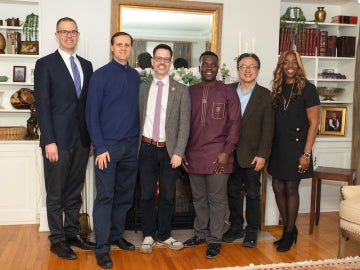
As part of a speaker series hosted by professor Grace An, students and faculty enjoy intellectual exchange with visiting scholars around gender, sexuality, and French thought.
Photo credit: Courtesy of Oberlin College
French and Italian News
Five Faculty Honored for Excellence in Teaching
Annual awards celebrate distinguished and sustained leadership across the college and conservatory.
Visiting Assistant Professor of Comparative Literature and French Anna Levett Receives Prestigious ACLS Fellowship
The ACSL Fellowship focuses its support on early-career, untenured scholars. In addition to funding, the award will allow Levett to decrease her teaching load and devote more time to her current book project on surrealism in Arab literature.

Watson Fellowship Winner to Explore Grief and Loss Across Cultures
Molly Gleydura’s desire to understand the grieving process and gain strategies that will assist families with the loss of a child will take her to New Zealand, Senegal, El Salvador, and Ireland this summer on a Watson Fellowship.

Next Steps
Get in touch; we would love to chat.

An outdoor Italian class at the arch in Tappan Square led by professor Ivana Di Siena.
Photo credit: Tanya Rosen-Jones ’97