
| << Front page | News | November 11, 2005 |
Public Forum is Strategic Plan Progress Report
 |
||
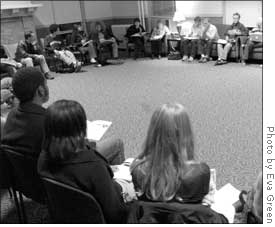
Strategic Forum: Students get informed on the Strategic Plan at Tuesday’s forum sponsored by Student Senate. | ||
The Strategic Plan for Oberlin College, adopted last spring, was the result of 18 months’ discussion by the Strategic Planning Task Force on how to better fulfill Oberlin’s mission in the next half-decade. Despite the amount of time spent, the plan is still in what student senator and College junior Ezra Temko calls “the very beginning stage.”
This past Tuesday, the people responsible for its implementation reported on their progress in the first public forum on the plan since March.
College President Nancy Dye began the meeting by outlining the main goals of the Strategic Plan and setting up the questions asked by the task force. These included: “How do we help students focus on goals? How do we create more verticality? How do we push...the agenda of environmental sustainability? How do we make ourselves into a world college?”
Provost Alfred MacKay spoke next, introducing the “working groups” that have been assigned the task of making recommendations to the General Faculty Planning Committee, an elected committee responsible for enacting any changes relating to the plan.
“I’ve participated in maybe four Strategic Plan exercises,” said MacKay. “The hard part is getting from the plan to doing something about it.”
There are seven working groups composed of faculty, staff and students, one for each specific aspect of the plan: Build Campus Community ; Curricular Support; Curricular Pathways; Support and Build the Faculty; Internationalize Oberlin; and Environmental Sustainability. There is also a Special Working Group, which is focused on achieving the ideal number of students and obtaining the money the college needs.
First up was the Internationalize Oberlin Working Group. Associate Dean of Studies Ellen Sayles coul not be in attendance, but Dean of Studies Kathryn Stuart read a statement prepared by Sayles. It said the group is examining “other practices at other institutions.”
Oberlin’s own internationality is being examined in terms of number of international students, summer and winter offerings and Shansi’s contribution. The group is “still collecting data” on the international content of Oberlin’s courses.
Stuart then spoke on behalf of the Curricular Support group. This group’s task is increasing Oberlin’s vocational focus.
David Kwakye, College senior, described a new Winter Term program.
“[Students] visit a number of firms to see what alums who work in finance and business are doing,” he said. He hopes to arrange a similar program for nonprofit work.
Representing the Curricular Pathways group, College junior Gabe Morden-Snipper reported his group’s current focuses: the sometimes “anticlimactic” senior year, getting students to make a narrative pathway of their education and increasing interdisciplinary connections, both between the divisions and between the Conservatory and the College.
“Are students all over the map because of the way credits are structured?” he asked. This is an issue being addressed by Curricular Pathways.
Professor of Geology Dennis Hubbard spoke about the progress of the Environmental Sustainability working group and “how to do more with less.”
College junior Travis Grout said the goal of the group was to make environmental sustainability “part of everything the college does.”
The Building Campus Community group was represented by Michael Henle of the mathematics department.
“Building campus community has a very broad charge,” he said, but named “maintenance of Oberlin’s diversity, incorporating athletics more into our community [and] dorm construction” as three specific topics the group is tackling. Accordingly, the group has recently split into subgroups.
Professor of Economics Kenneth Kuttner reported that his working group, Support and Build the Faculty, is focusing on recruiting, retaining and supporting the best faculty possible.
“We’re looking at averting faculty burnout, things like salary and compensation, and facilitating faculty communication,” he said.
His group would like to see some kind of faculty center where professors can exchange ideas. The group is also looking at faculty diversity as an overarching principle.
Finally, President Dye spoke for the Special Working Group.
“This is a difficult time for private and public higher education in this country,” she said. “This concern about the cost of higher-ed has become a huge driver. ”
She described the need to raise tuition in order to maintain financial health.
“Students will not pay more tuition per student,” she said. “But overall Oberlin does need to create more tuition revenue. What we have to spend is going up much faster than revenue.”
Dye framed the need to raise tuition costs as an access issue.
“More diversity depends on more tuition revenue,” she said.
The student senate encourages anyone who has a suggestion on any aspect of
the strategic plan to send suggestions to
senate@oberlin.edu. Anyone curious about
the plan can view it at:http://www.

About us
Subscriptions
Advertising