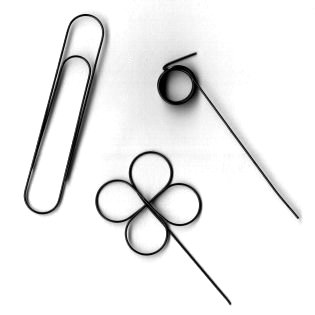
Use the overhead projector to
show
the shape
of a piece of nitinol wire. Bend the wire. When
heated,
wire
returns to its original shape.
Cool the super-elastic wire in
liquid nitrogen.
Deform the wire. Allow it to return to room temperature
and it
will
return to its original shape.
NOTES
Nitinol wire undergoes a
solid-solid
phase
transition between the low-temperature "martensite" form in
which the
wire
is easily deformed and the higher temperature "austenite" form
in which
the wire is rigid and springy.
We have samples made of two
different nitinol
alloys that differ in the percent composition of nickel and
titanium
and
in their transition temperatures, so that one is in the
martensite
phase
and the other in the austenite phase at room temperature.
The shape memory metal has a
transition temperature
of 55° C.
The super elastic samples have a
transition
temperature of 14° C.
REFERENCES
Teaching General Chemistry:
A
Materials
Science Companion, Arthur B. Ellis et al. 1993 American
Chemical
Society.