Mechanics > Gravitation DCS# 1L10.30

CAVENDISH EXPERIMENT


APPARATUS
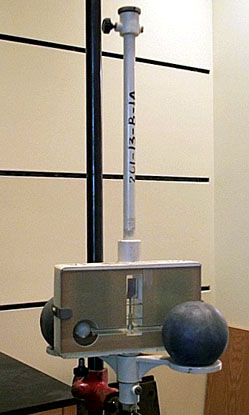
Cavendish apparatus
201A
laser
202-21-B6
stopwatch
101-05-D4
masking tape
202-02-E3
meter stick
101-05-F


DESCRIPTION
A torsion balance with an optical lever is used to determine the universal gravitational constant.  Start with the large lead balls at one extreme and note the position of the laser spot.  Move the balls to the other extreme, allow the system to settle (which takes 1-2 hours), and note the new position of the spot.  Use the distance between the two to calculate G.

Meiners suggests a quicker version of this in which the initial acceleration of one of the small balls is calculated from the distance the laser spot travels in the first 60 seconds.  At equilibrium the gravitational torque on the torsion pendulum part is equal and opposite to the torque due to the support wire.  Immediately after the large masses are swung to their new positions, these two torques have the same magnitude and direction - the torsion wire remains twisted for a short time since the pendulum has a large rotational inertia and its period of oscillation is long ( ≅ 10 minutes).
So Fnet = 2GMm/r2 = ma where a = 2sball/t2 and can be determined using the optical lever.

M = 1.5 kg
m = 0.015 kg
distance between large and small masses, r = 0.039 m
distance between small mass and pivot point = 5.0 cm


NOTES

The two screws that release the masses should be loosened gently and at the same time.

Make sure the apparatus is level and the wire is free to twist.

Allow plenty of time for the system to reach equilibrium prior to class.

A time lapse video is available on the Physics Cinema Classics video disk.

REFERENCES
Meiners 8-8.7