Mechanics > Properties of Matter > Crystal Structure DCS# 1R50.xx

ACOUSTIC 1-D CRYSTAL ANALOG


APPARATUS
pvc acoustic crystal model
202-alcove
speaker with pvc coupler
202-16-F
microphone
202-07-E3
amplifier
202-09-B
laptop
206

DESCRIPTION
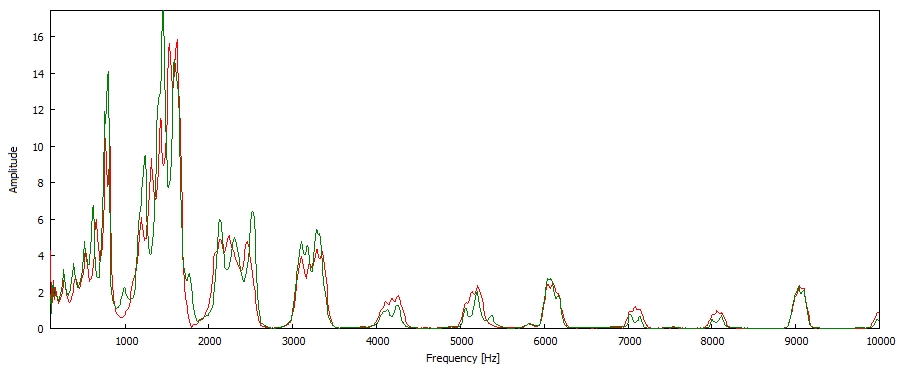
The crystal model is a tube with a periodic array of side branches.  There is a speaker at one end and a computer-interfaced microphone at the other.  The computer sound card and software is used to run a frequency scan and record the transmission spectrum.   Sound waves traveling along the tube are partially reflected at the junctions to the side branches because of the change in impedance.  When the array spacing is equal to an integer multiple of one-half wavelength, the reflected waves interfere constructively and little sound is transmitted to the microphone, so gaps appear in the transmission spectrum.  This is analogous to interference of the electron wavefunction in a crystal lattice.

The side branches are 20.5 cm apart.  The frequency spectrum shows band gaps centered around 830, 1660, 2490, and 3320 Hz

Set up the software to sweep from 0 to 4000 Hz in 10 Hz steps, with the time per step set to 150 ms and the FFT filter on. 


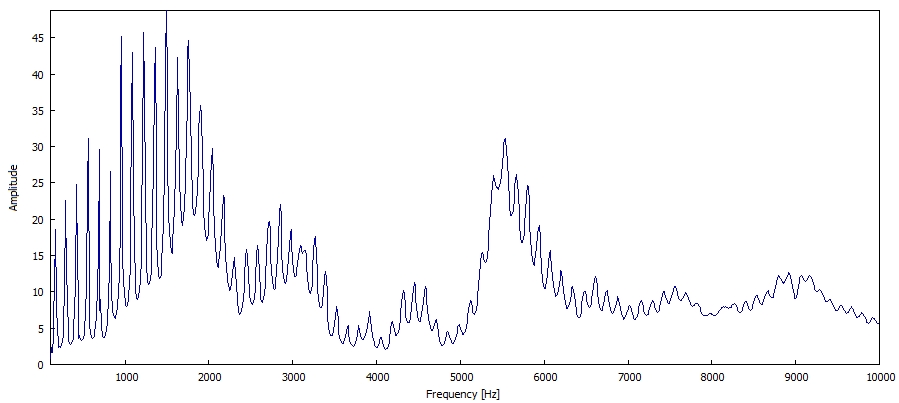
The tube is 3.05 m long.  The peaks within the transmission bands at 57 Hz intervals are the resonance peaks due to the length of the tube.  The small peaks within the gaps occur at the resonance frequencies of the sidebranches.

For comparison, the file "straighttubespectrum.dat" shows the spectrum for a tube of the same length without side branches:


A longer section representing a crystal defect can be inserted in the middle, to introduce an allowed state within the band gap.
NOTES
The program is spectrumSLC.exe.

The microphone should not touch the wall of the tube.

REFERENCES
JASA 112, 1353 (2002)

AJP 50, 1137 (1982)
AJP 72, 255 (2004).

AJP 70, 689 (2002).