K-REV: The KNIGHT-REVISION OF HORNBOSTEL-SACHS
Organology, or the scientific study of musical instruments, has ancient roots. In China, a system of classification known as the pa yin or "eight sounds" was devised in the third millennium BCE. It was based on eight materials used in instrument construction (but not necessarily in sound production) and allied to other physical and metaphysical phenomena. More recently, but still in ancient times, the Indian sage Bharata outlined in his Natyashastra (ca. 200 CE) a classification based on how the sound is produced: by blowing (sushira), setting a string in motion (tata), hitting a stretched skin (avanaddha), or hitting something solid (ghana). This system endures as a worldwide phenomenon today because Victor Mahillon adopted it for his catalog of the instruments in the Brussels Conservatory museum in the 19th century, and because his system was picked up in turn by Erich M. von Hornbostel and Curt Sachs in producing their seminal Systematik der Musikinstrumente (Classification of Musical Instruments) in 1914.
Hornbostel and Sachs sought to universalize the Mahillon catalog by developing a hierarchy of terms that could encompass all the methods of sound production known to humankind. They used three of Mahillon's terms: aerophone, for the "winds and brass" of the orchestra and all other instruments that produce a sound by exciting the air directly; chordophone, for all stringed instruments (including the keyboards); and membranophone for drums. Hornbostel and Sachs replaced Mahillon's fourth term, autophone (for instruments whose body itself, or some part of the body, produces the sound – the Indian ghana type), with their newly coined term, idiophone, to avoid the ambiguous implication that an "autophone" might sound by itself.
In Hornbostel-Sachs, an instrument is assigned a number. It may be a single digit, such as 1, indicating nothing more than the broad class, such as idiophone. More typically, an H-S number might have 3 to 6 digits, or as many as 9 or 10 (separated every three by a decimal point), to provide the degree of specificity needed to distinguish one instrument from another. The numbering method is based on the Dewey Decimal System, which was in common use by libraries at the time the system was devised.
Although Hornbostel-Sachs is the most widely used method for classifying instruments, applied to instrument collections worldwide, translated into English in 1961, and taught regularly, it is also fraught with problems that have been tackled by many scholars over the century since its introduction. The system now includes a fifth term, coined by Francis W. Galpin in 1937, electrophone. The most current version of Hornbostel-Sachs, prepared in 2011 by the MIMO Consortium (Musical Instrument Museums Online), is available HERE.
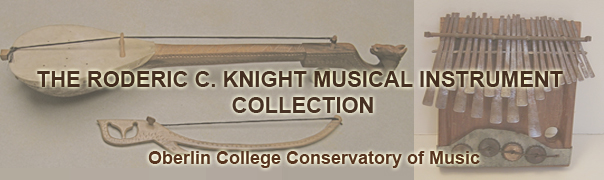
The establishment in 2008 of the Roderic C. Knight Musical Instrument Collection at Oberlin College served as a catalyst for a new approach. It is called the Knight-Revision of Hornbostel-Sachs, or K-Rev for short. The four H-S terms are retained, as is the numbering system, but because the internal subdivisions of the classes have been largely reworked, the numbers do not match the H-S numbers. To assure the two are never confused, K-Rev numbers begin with a letter, as follows:
- Y for Idiophone (Y is used for I to avoid resembling a Roman numeral I) – a solid or hollow body produces the sound
- M for Membranophone – a stretched membrane or diaphragm produces the sound
- C for Chordophone – a stretched string produces the sound
- A for Aerophone – blowing air into an object or moving it through the air produces the sound
- E for Electrophone – electric or electronic circuits produce the sound
The RCK Collection may be used to study K-Rev. A K-Rev number has been assigned to each instrument in the collection. A one-page overview of the system is presented below. To learn more, follow the link below to four items in downloadable pdf format:
- Hornbostel-Sachs in the original German
- The one-page overview below
- This intro plus the one-page overview
- The full 44-page Knight-Revision of Hornbostel-Sachs
The Knight-Revision of Hornbostel-Sachs
Overview of the Knight-Revision of Hornbostel-Sachs (K-Rev) © 2015 Roderic Knight
(Please use the pdf version in the link above for printing)
| IDIOPHONE Y1 Concussion 11 Plaque 12 Bar 13 Dish 14 Vessel 21 Plaque 22 Bar 23 Vessel 31 Globe Y4 Shaken 41 Vessel 42 Sliding 43 Solid 43.1 Sheet 43.2 Spring 44 Concussion 45 Sympathetic Y5 Scraped 51 Organic (wood, gourd) 52 Manufactured (metal, cloth, sandpaper) 61 Solid 62 Vessel Y7 Plucked 71 Frame 72 Board Y8 Blown 81 Wood 82 Metal Y9 Deformed 91 Diaphragm 92 Blade
|
MEMBRANOPHONE
M1 Struck 11 One head, open 11.1 Vessel 11.11 Cylinder 11.12 Cone 11.13 Waisted 11.14 Barrel 11.15 Goblet 11.16 Vase 11.17 (other shapes) 11.2 Frame 11.21 Circular 11.22 Polygonal 12 One head, closed 12.1 Deep (vessel) 12.11 Cylinder 12.12 Kettle 12.13 Barrel 12.2 Shallow (frame) 13 Two heads 13.1 Vessel 13.11 Cylinder 13.12 Cone 13.13 Hourglass 13.14 Barrel 13.15 Ang. Barrel 13.2 Frame M2 Shaken 21 External strikers 21.1 Opposed hemispheres 21.2 Hourglass 21.3 Frame 22 Internal strikers 31 One head 32 Two heads M4 Sympathetic (mirliton)
|
CHORDOPHONE
C1 Variable tension 11 No neck 12 Single neck 13 Forked neck C2 Musical bow 21 Mouth resonated 22 Gourd resonated C3 Pluriarc C4 Harp 41 Strings-over 41.1 Forked 41.2 Spike 41.21 Curved neck 41.22 Straight neck (Bridge harp) 42 Strings-in 42.1 Arched 42.2 Angled C5 Zither 51 Stick or bar 52 Tube 53 Raft 54 Board 55 Box 56 Trough 57 Harp zither 58 Frame C6 Lute 61 Plucked 61.1 One piece 61.2 Multi-part 61.21 Neck attached 61.22 Spike 61.23 Half-spike 62 Bowed 62.1 One piece 62.2 Multi-part 62.21 Neck attached 62.22 Spike 62.23 Half-spike C7 Lyre 71 Bowl 72 Box
|
AEROPHONE A1 Ambient (Free) 11 Slicing 12 Beating (bull roarer) 13 Whip (sonic boom) 21 Open 21.1 Edge (flute) 21.11 Vessel 21.111 No duct 21.112 Duct 21.12 Vertical 21.121 No duct 21.122 Duct 21.13 Oblique 21.14 Transverse 21.2 Chamber duct 21.21 Simple 21.22 Vented 21.3 Corrugated pipe 21.4 Siren (pulsated) 22 Reed 22.1 Free (Hard) 22.2 Beating (Soft) 22.21 Normally open 22.211 Conical bore 22.211.1 Single reed 22.211.2 Double reed 22.212 Cylindrical bore 22.212.1 Single reed 22.212.2 Double reed 22.212.3 Free on pipe 22.213 Mouthpiece only 22.22 Normally closed 22.221 Split or crushed 22.222 Membrano-reed 22.3 Ribbon Reed 23 Lip reed 23.1 Narrow compass 23.11 Fixed length 23.12 Variable length 23.2 Wide compass 23.21 Fixed length 23.22 Variable length (fingerhole, slide, valve) 31 Closed 32 Open |